
Table of Contents[Hide][Show]
Examination of pastured lard vs tallow balms, creams, salves, and lotions, and which is best for all-natural skincare based on nourishing, traditional animal fats.
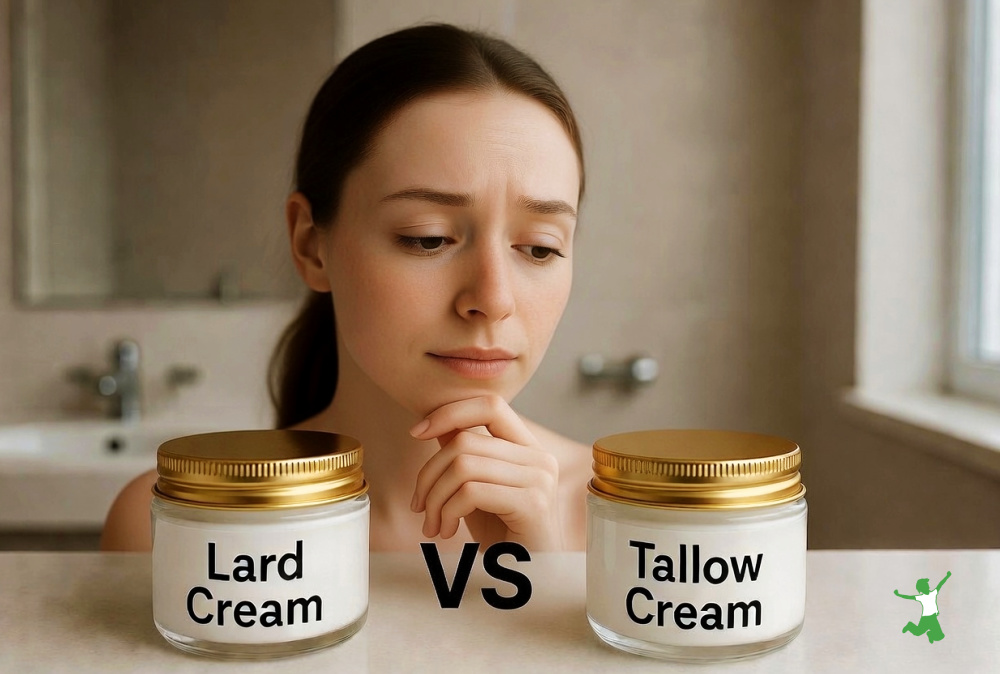
With natural skin products based on animal fats soaring in popularity as they are closest to the fatty acid profile of human skin (compared to the toxic, rancid seed oils used in most commercial lotions/creams), I’ve increasingly received inquiries from readers about which is best….pastured lard or tallow-based balms/cream/salves/lotions?
While the answer to that is easy…BOTH tallow and lard are great for natural skincare (as long as the product in question does not contain unnecessary additives)…there are indeed important differences between the two that might make you choose one over the other.
I myself prefer pastured lard cream especially for facial use (I make my own vanilla body lotion for arms/legs…which has gotten great reviews over the years!).
Let me tell you why.
Sensory Differences
I am rather sensory sensitive, so how a skincare product feels on my skin is incredibly important.
That said, there is a clear sensory difference between tallow-based creams compared to lard-based versions.
Tallow often feel heavier, waxier, and greasier on the skin.
By comparison, lard feels lighter, creamier, and more absorbent…at least to me.
Again, this is a personal preference and actually of great importance here in hot, humid Florida! Greasiness doesn’t fly in this climate, especially in the summer.
Please note that if you love your tallow skincare, that is great! This is just my opinion that I am sharing in case you are going to try these types of products for the first time and don’t know what to use first.
Tallow and Lard Fatty Acid Composition
There are reasons why lard feels lighter and more absorbent when applied to the skin.
It isn’t just anecdotal — the distinct texture variation stems from fundamental differences in their fatty acid compositions and physical properties.
Specifically, lard and tallow exhibit different melting behavior, which subsequently affects how they interact with skin temperature and sebum.
While both tallow and lard are nutrient dense, traditional fats normally rendered from the kidney area (suet and leaf fat, respectively), their molecular makeup differs significantly, beginning with their fatty acid composition.
Saturated fats pack tightly and have higher melting points.
By comparison, monounsaturated fats are more fluid, with polyunsaturated fats are even more liquid.
Tallow (averages):
- Saturated fats: ~50% (palmitic acid ~25%, stearic acid ~19%)
- Monounsaturated fats: ~42% (oleic acid ~36%)
- Polyunsaturated fats: ~4%
Lard (averages):
- Saturated fats: 38–43% (palmitic acid 25–28%, stearic acid 12–14%)
- Monounsaturated fats: 47–50% (oleic acid 44–47%)
- Polyunsaturated fats: 6–10% (mainly linoleic acid)
As you can see, tallow contains roughly 20% more saturated fats — especially stearic acid — and lower (fluid) oleic acid (the main type of fat in extra virgin olive oil).
Stearic acid has a very high melting point (around 156 °F/ 69°C), contributing to the overall firmness of tallow based skincreams.
Lard’s higher oleic acid content and 20% lower saturated fats makes it more fluid, softer and more skin-compatible in terms of spreadability right out of the jar onto your skin.
Melting Points and Skin Temperature Interaction
Now that we’ve established that the fatty acids in tallow are roughly 20% higher than leaf lard in saturated fats (that remain very firm at room temperature), let’s talk more about the melting point of the fatty acids in both these animal fats.
Melting point is critical for how a fat feels on the skin. Human skin surface temperature is typically around 90–93°F (32–34°C).
The melting point for tallow generally ranges from about 104–122°F (40–50°C) or higher, depending on the source and rendering. Remember that about 10% of of tallow is stearic acid with a sky-high melting point of around 156 °F/ 69°C.
This is why tallow creams remain very solid even after they are applied to the skin.
By comparison, lard-based creams have an overall melting point of around 86–104°F 30–40°C.
This is why lard creams are easy to scoop out of the jar with your fingers and will melt more easily into the skin once applied.
In summary, when you apply a tallow cream, the fat doesn’t fully soften very quickly. It’s harder to remove from the jar and stays more structured, forming a thicker, more occlusive film that sits on the skin’s surface longer.
This creates the classic “greasy” or waxy sensation many describe — protective but noticeable.
Lard cream, by contrast, melts faster upon contact with skin. It becomes more fluid, spreads easily, and integrates better with the skin’s natural oils. The result is a lighter, silkier feel with quicker perceived absorption and less residue.
Which Should You Choose?
There’s no universal “better” option when it comes to tallow versus lard-based skincare.
Tallow’s higher level of saturated fats gives it excellent stability and barrier protection, making it ideal for intensive repair for very dry skin or cracked heels and hands.
Lard’s profile delivers a more elegant feeling application for everyday skincare experience with less greasiness.
Many formulators blend the two fats and/or add liquid oils like jojoba or olive oil to balance tallow’s firmness.
The greasiness of tallow cream versus lard cream is not a flaw — it’s a predictable outcome of chemistry.
The bottom line is that both fats are nutrient-dense, time-tested options for natural moisturization.
What you choose should be based on your sensory preferences and where you live.
The more solid, thicker, barrier-type feel of tallow reflects how it is best for long-lasting protection over faster, lightweight absorption of lard.
Thus, if you live in a colder/drier climate with safeguarding of the skin required more than rapid absorption, then tallow is your best bet. If you live in a hotter, more humid climate, lard creams (this is the brand I use) are hands-down the winner for silkier application and more rapid absorption.